
Remembering Hurts but Forgetting Kills
The political calculus of collective memory: Archives of ash, algorithms of blood, and ghosts disrupting the propaganda of forgetting

In the previous post, we analyzed how media desensitization numbed us into scrolling through tragedies like they’re Netflix thumbnails—swipe left, swipe right, no tears left to spend. In this one, we dig into the underbelly of it all: memory, that manipulated archive where the victors write with invisible ink the names that didn’t matter.
As the legal scholar Martha Minow points out in her book Between Vengeance and Forgiveness, collective memory is not a wax museum, but a workshop where myths are sculpted—with chisel and hammer—that justify wars or bury mass graves. But, is this process of memory shaping a fair one? And as Paul Ricoeur warns, paraphrasing him freely, forgetfulness is not a black hole: it is an operating room where power operates with a selective scalpel. Memory isn’t a mirror of facts but a mosaic of what we cherry-pick to remember and, crucially, what we redact.
Why do some events become symbols and others fade? And who gets to ghostwrite the line between mourning and propaganda?
9/11 is textbook: serves as a clear example of how a historical event becomes a cornerstone of a nation's collective memory. This event, aside from being a human tragedy, was quickly instrumentalized as a founding myth of the war on terror. The slogan Never Forget has been perpetuated in political speeches and commemorative acts, such as the memorial at Ground Zero, where the names of the victims are etched in bronze. However, as Minow analyzes, monuments and memory rituals are not neutral: they are performative acts that reinforce a narrative of national unity in the face of an external enemy. This insistence on remembrance serves a dual purpose. It's not just about honoring the victims; it's also about keeping alive a story that justifies policies like the invasion of Iraq (2003-2011) and Afghanistan (2001-2021), the tightening of immigration laws, and the implementation of security measures that violate citizens' privacy. This had served as an ethically ambiguous justification for the expansion of mass surveillance and the use of questionable coercive methods that violate basic human rights.
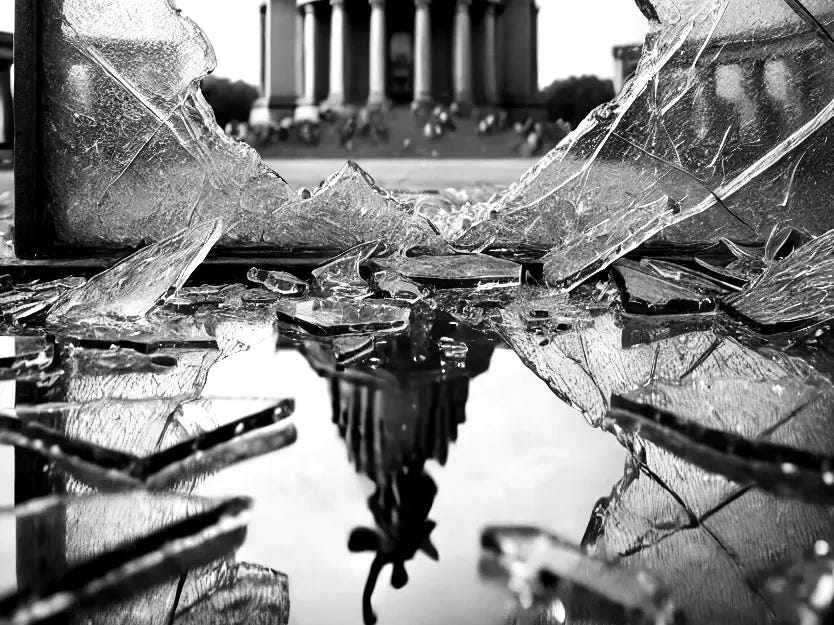
Never Forget mutated: from collective grief to a password for citizen surveillance. While victim families like September 11th Families for Peaceful Tomorrows scream “we don’t want our grief to be weaponized. Every bomb dropped in our name dishonors the memory of those we lost” the state normalized torture and pervasive spying. When memory feeds fear, it becomes a control lever to mute dissent and eternalize war.
But some corpses don’t fit the museum of useful traumas.
While 9/11 remains at the center of the historical narrative, another attack against the United States—the bombing of the U.S. embassy in Beirut in 1983, linked to Hezbollah and Iranian-backed militants—seems to have been forgotten. Unlike 9/11, this event, which claimed the lives of 241 American soldiers, occurred in a context where the U.S. sought to project an image of invulnerability during the Cold War. The intervention in Lebanon (1982-1984) was unpopular and controversial, and acknowledging the attack as an act of terrorism would have weakened the narrative of moral superiority in the face of the USSR. Thus, the forgetting of Beirut was not an oversight, but a political decision to avoid questioning the role of the U.S. in the Middle East. As Minow said, states often bury events that expose their vulnerability or contradict their heroic self-image. In Jacksonville, North Carolina, a plaque by victims’ families gathers dried flowers: an intimate grief that defies state-sanctioned silence. No national monuments, no presidential eulogies—here, forgetting isn’t oversight but policy.
Walter Benjamin spat it raw: ‘There is no document of culture that is not at the same time a document of barbarism. And just as it is not free from barbarism, neither is the process of transmission in which it passes from one victor to the next.’ Sometimes history isn’t a road to progress—it’s a graveyard where victors loot tombstones to build thrones. Collective memory, then, is a political triage of catastrophes: which to display, which to disappear.
And forgetting turns genocidal in domestic racial violence. The Tulsa Massacre (1921), where a white mob destroyed the neighborhood of Greenwood and killed over 300 people, was erased from official history for nearly a century, but not from Viola Fletcher’s memory. At 107, she recalled to Congress how Black Wall Street smelled of burning flesh, not money—a firsthand rebuttal to the epistemic violence that labeled the massacre a riot.
This forgetting isn’t passive—it’s violence that strips victims of their humanity. Even today, as Congress debates reparations, political sectors insist on minimizing the event as an isolated incident. The recent resurgence of memory surrounding Tulsa, driven by descendants of the victims and documentaries like Watchmen (HBO), exemplifies the moral act of remembering. However, this process faces resistance: only 3 of the 121 victims identified in mass graves have received proper burials since 2020. The rest? Footnotes in a nation’s lie. This tension reveals that remembering is not enough: memory must be accompanied by concrete actions to repair historical harm.
The contrast sharpens when comparing Tulsa to the Birmingham church bombing (1963). Four Black girls killed by white supremacists became a sanitized national symbol of racial progress and the crime became integrated into the national narrative as a symbol of the civil rights struggle. The key here is context: the movement led by figures like Martin Luther King Jr. turned the tragedy into a catalyst for change, aligned with a narrative of progress that those in power could absorb. Today, the site of the attack is a national monument, and the event is taught in schools as part of the overcoming of racism. However, this official memory has limits: it only includes what does not radically challenge the status quo. Birmingham is remembered as a turning point, but Tulsa—which exposes a racism with no redemption—took a century to be acknowledged. The difference lies not in the magnitude of horror, but in its political utility: one fits the tale of a nation that learns from its mistakes; Tulsa reveals a nation that hides them.
Minow’s theory cracks it open: what is remembered or forgotten is not accidental, but strategic. In the case of 9/11, the state invests in memory rituals to sustain security policies; in Beirut or Tulsa, silence protects myths of invulnerability or equality. But forgetting isn’t benign—it’s impunity that shields perpetrators and starves victims of justice. As Minow writes, “forgiveness without memory is complicity; memory without justice is a trap.”
The challenge is to transform memory into an instrument of justice, not of power.
In the digital age, this battle over memory takes on a chilling new dimension. Algorithms, programmed to predict and influence our every move, curate not just what we see—but what we are blind to. Social media platforms, once hailed as spaces of democratized communication, now amplify certain traumas—often cherry-picking which pain is worthy of attention—while quietly erasing others. The horrors of police violence, for example, are often presented in snippets, reduced to viral content that fuels outrage for a few days before being buried under the weight of the next trending hashtag. Grassroots movements like #SayHerName or efforts to reclaim erased histories, like the 1619 Project, push back, seeking to restore the forgotten narratives of marginalized communities. Yet, these movements also fight against a tidal wave of disinformation, algorithmic bias, and the pervasive force of historical revisionism. But who audits the engineers of erasure?
And who guards our memory in this new landscape? While algorithms bury inconvenient truths beneath layers of entertainment and distraction, there are still those, like a group of teenagers in Tulsa, who gather to clean vandalized gravestones, holding fast to a history that others wish to forget, or Palestinians live-tweeting under bombs so Gaza isn’t another Beirut.
Perhaps the answer is not in the archives, nor in the coded algorithms that shape our perceptions, but in the hands that refuse to let go of the chisel—those who, in the face of erasure, carve out spaces for truth, no matter how small or invisible they may seem.
Collective memory, in the right hands, isn’t a tribute—it’s a shovel to dig up tomorrows. Minow is right: “Remembering hurts, but forgetting kills.” Ricoeur would add: “And only the crazy believe that wounds heal by hiding the knife.”
And we took the liberty of adding this: Memory isn’t just recalling—it’s challenging, disrupting, refusing to comply.
If you find value in this, please share it. Building a critical and informed community is essential to challenging mainstream narratives and truly grasping what’s at stake. Also, feel free to check out our other posts—each one adds a piece to the bigger picture.